
Faster feedback
Tools and local models can handle many small iterations without network waits or large context transfers.
A powerful model can do almost anything, but that does not mean it should do everything. ChatCode aims to build a router that knows when deterministic tools are enough, when local AI is sufficient, and when cloud or frontier models are necessary.
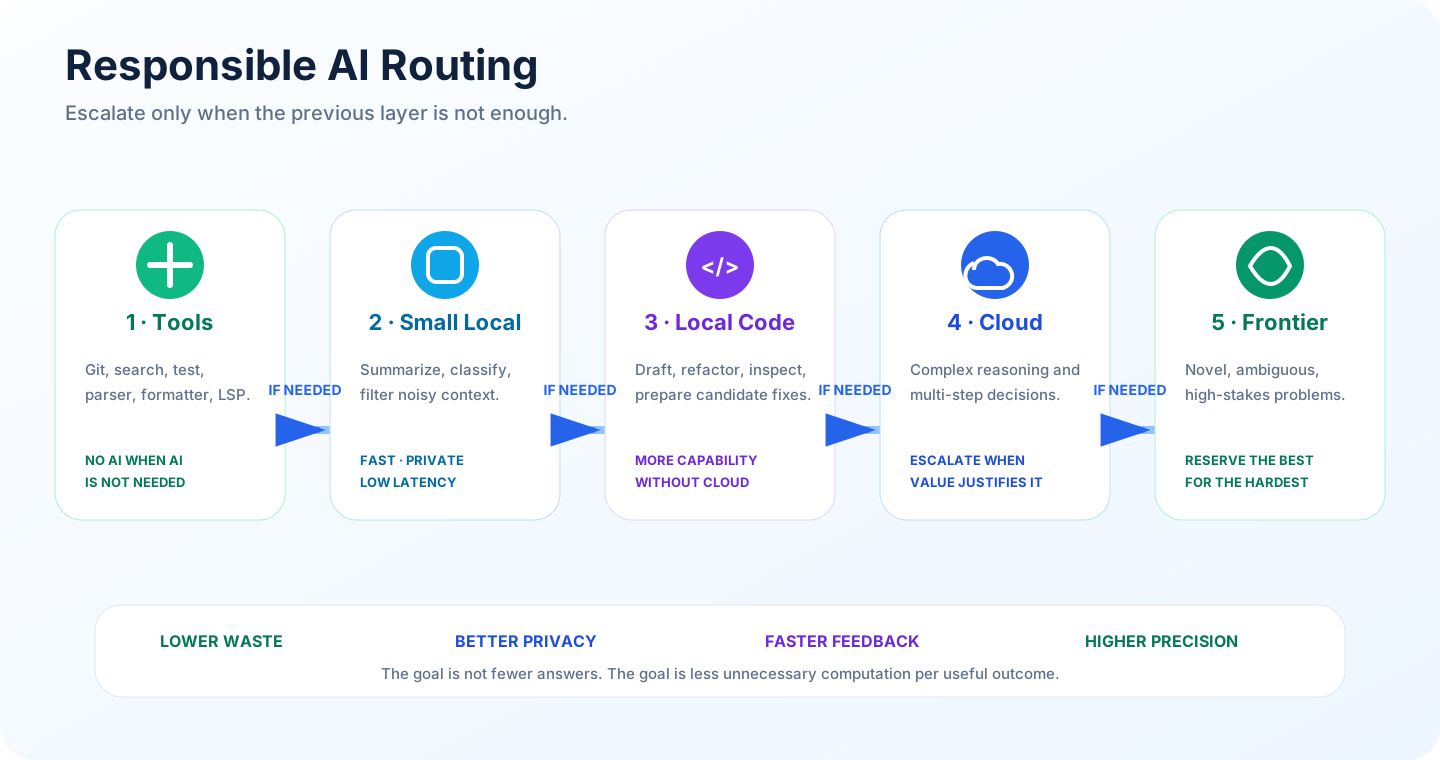
Many software development tasks already have excellent deterministic solutions. Git knows exactly which files changed. Test runners know which tests failed. Parsers understand syntax. LSPs know symbols. Formatters know formatting rules. These jobs do not need a large model to guess what the computer already knows precisely.
That is the first layer of Responsible AI Routing: never spend intelligence where computation is enough.
Local AI is useful for tasks that require language or pattern understanding but not necessarily frontier reasoning: summarizing logs, grouping errors, preparing context, drafting, classifying changes, creating candidate patches, or finding likely source areas.
The principle is not local at any cost. A weak local model should not keep a task it cannot solve. The router must know when to escalate.
Search, Git, parser, test, formatter, static analysis.
Summarize, classify, filter, compress context.
Draft, small refactors, candidate fixes, and preliminary verification.
Complex reasoning, long context, multi-step work, and multiple tradeoffs.
Novel, ambiguous, difficult, or high-value problems that need the strongest capability.
ChatCode should not delay a strong-model call just to improve an “AI saved” metric. If going straight to cloud makes the result faster, more accurate, or safer, that is the correct choice. The metric to optimize is resource cost per useful verified outcome, not the lowest possible request count.
Tools and local models can handle many small iterations without network waits or large context transfers.
Data that does not need to leave the device should stay there, as long as the local path meets the task requirements.
Frontier models receive filtered context, test evidence, and clear dependencies instead of a chaotic source dump.
When confidence is low, tests fail, or the problem exceeds local capability, the router escalates instead of persisting blindly.
The best experience is for users to state the outcome they want. ChatCode analyzes the task, project state, data sensitivity, machine resources, and quality requirements, then chooses an appropriate path. Users still retain policy controls: maximum quality, balanced, cloud-saving, or local-only.
The right intelligence, at the right place, for the right task.